Why Milton GA Luxury Living Appeals to Discerning Buyers
May 7, 2026
May 7, 2026
Looking for a place that feels refined, private, and still connected to metro Atlanta? Milton stands out because it offers something many luxury buyers struggle to find: room to breathe without feeling isolated. If you are weighing horse property, estate living, or an upscale home with more land and privacy, Milton gives you a clear picture of what that lifestyle can look like. Let’s dive in.
Milton’s appeal starts with how the city is planned. According to the city, Milton is about 30 miles outside Atlanta, covers 39.12 square miles, and is about 85% agriculturally zoned. In many of those areas, residential lots must be at least 1 acre.
That matters because Milton does not read like a typical dense suburban market. The city reports that more than 90% of land within city limits is low- or very low-density residential, supported by sewer limits and urban-growth boundaries. If you want a home setting with more open land, deeper setbacks, and a quieter feel, Milton was built to preserve that pattern.
The numbers also reinforce its premium position. In the city’s FY2025 profile, Milton reports a population of 41,606, a median home value of $778,221, and an average home value of $826,211. Those figures help explain why buyers often see Milton as a space-oriented luxury market rather than just another North Fulton option.
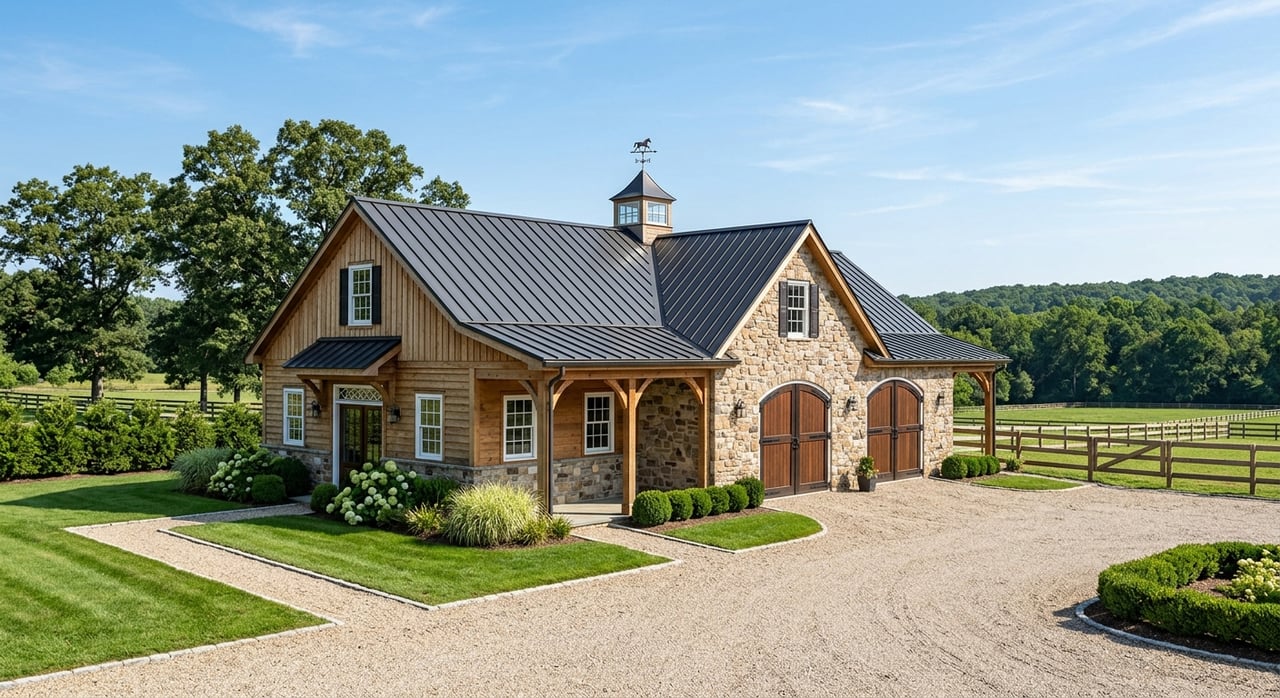
Milton describes itself as a North Fulton community with rural and equestrian roots, high-end residential, charming architecture, farms, parks, trails, shopping, and dining. That combination is a big part of the draw. You are not choosing between upscale living and a more relaxed setting. In Milton, those two ideas often work together.
The city also organizes activity around a few key commercial districts, including Birmingham, Crabapple, and Deerfield. This gives buyers a balance that can be hard to find. You can enjoy privacy and larger lots while still having practical access to shops, dining, and everyday services.
Location adds to that appeal. Milton borders Cherokee County to the north and west, Forsyth County to the east, Roswell to the southwest, and Alpharetta to the south. For many buyers, that means Milton feels distinct from Atlanta’s denser areas while remaining practical for commuting and access to North Fulton job centers.
For equestrian buyers, Milton is not just horse-friendly in theory. The city says it has a strong equestrian community and even supports an official Milton Equestrian Committee. That tells you horses are not a side note here. They are part of the city’s identity.
A city-commissioned 2024 farm census found more than 200 active horse farms around Milton. Just as important, those farms are spread throughout the city rather than clustered in only one pocket. If you are searching for a horse property, that wider distribution creates more ways to match lifestyle, land, and location.
Milton has also used policy tools to help preserve that pattern. The city’s large-lot incentives page defines a large lot as 3 acres or bigger and discusses incentives that could support covered riding arenas, commercial horse farms, and rebuilding equestrian structures. The same city materials note that many residents were drawn to Milton because of large lots, horses in pastures, and homes set back from the road.
Milton is not one single type of luxury market, which is helpful if you want to narrow your search. The city’s character-area descriptions show how different parts of Milton support different kinds of lifestyles, including equestrian living.
In Birmingham, the city references equestrian facilities and estate residential uses. Arnold Mill is described as a more rural area with nearly 100 parcels across almost 520 acres, including equestrian properties and other rural agricultural and residential uses. Central Milton includes equestrian estates alongside low-density residential uses.
Sweetapple is described by the city as its most rural character area. It is dominated by horse farms, pastures, woodlands, and two equestrian estates. For buyers who want the most pastoral feel, that description makes Sweetapple one of the clearest examples of Milton’s horse-country appeal.
Luxury in Milton is not only about square footage. It is often about the full setting around the home. Larger lots, mature landscapes, pastures, wooded views, and distance between neighboring homes can shape the experience just as much as interior finishes.
That is one reason Milton attracts buyers who want privacy without giving up convenience. In many parts of the city, the home itself is only part of the value. The land, the streetscape, and the lower-density setting all contribute to the overall lifestyle.
For some buyers, that means estate homes with equestrian potential. For others, it means a luxury home in a neighborhood with private amenities or a golf setting. Milton supports both, which broadens its appeal in the upper-end market.
Equestrian appeal may be Milton’s signature, but golf is also part of the local lifestyle. The city’s materials mention White Columns’ golf section, and White Columns Golf Club is listed among Milton’s principal employers. Central Milton is also described as having high-value residential developments anchored by golf courses and other private amenities like pools, tennis courts, greenspace, and trails.
This is important because Milton’s golf presence does not feel like a dense resort environment. Instead, it tends to show up in neighborhood-club or legacy-community settings. That creates another path for luxury buyers who want amenities and a club atmosphere while still enjoying a lower-density backdrop.
Crooked Creek is another example named in the city’s character-area narrative. The city notes that Bethany includes the Crooked Creek Golf Club and the adjacent Crooked Creek community. For buyers comparing home styles and settings, that adds variety to Milton’s luxury inventory.
Milton also shows how open space remains part of the city experience, even as the market evolves. Milton City Park and Preserve sits on the former Milton Country Club property, which the city acquired in 2018. The 137-acre site was converted into a public park-and-preserve campus with a large passive preserve and a smaller active recreation area.
That reuse says a lot about the city’s priorities. Milton has found ways to preserve greenspace, trails, and outdoor character even as former golf land changes use. For buyers, that helps support the overall sense of space and landscape that defines the area.
The city also regulates personal transportation vehicles and notes they are commonly associated with golf carts. Planning around PTV use in places like Crabapple and White Columns suggests a neighborhood scale where trails, club areas, and low-speed local circulation are part of daily life in some areas.
One of Milton’s strengths is range. If you assume every home here sits on several acres with a barn, you may miss parts of the market that still fit a luxury lifestyle. The city’s own descriptions make it clear that Milton includes multiple housing patterns.
Crabapple is described as a destination area with shops, dining, and entertainment. It includes character neighborhoods, townhomes, and subdivisions with amenities. If you want a more connected, walkable-feeling setting with services nearby, Crabapple may deserve a closer look.
Bethany is described as a vibrant area with neighborhoods within walking distance of schools, shopping, dining, and entertainment, along with a variety of home designs, lot sizes, and amenities. Arnold Mill and Sweetapple lean more rural and estate-like, while Central Milton is known for large lots over 1 acre, high-value homes, horse farms, pastures, woodlands, and golf-anchored private amenities.
Deerfield creates the biggest contrast. The city describes it as Milton’s chief commercial driver and a live-work-play area with future mixed-use potential. For buyers relocating to the area, this helps explain why Milton can offer both pastoral neighborhoods and a few more compact commercial nodes.
A quieter setting only works if daily logistics still make sense. Milton’s location helps on that front. The Deerfield area sits near Windward Parkway and GA-400, which can be a meaningful advantage if you want more privacy and land without giving up access to North Fulton.
Highway 9 also plays a key role in the city. Milton describes it as the backbone of its main commercial area, running three miles from Windward Parkway to the Forsyth County line. The city’s redesign plans include pedestrian and bicycle facilities, improved crossings, and other safety upgrades.
For many buyers, this is part of Milton’s practical luxury story. You can prioritize space, scenery, and privacy while still keeping a reasonable connection to shopping, dining, and regional travel routes.
If you are considering Milton, it helps to define what kind of luxury lifestyle you want first. Some buyers want true horse property with acreage and equestrian structures. Others want a luxury neighborhood with golf, amenities, and more privacy than they would likely find in denser parts of metro Atlanta.
It is also important to remember that Milton is not uniform. A home near Crabapple or Deerfield can feel very different from one in Sweetapple or Arnold Mill. Understanding those distinctions can save you time and help you focus on the areas that actually fit how you want to live.
At Property Guys of Atlanta, we believe the best luxury buying decisions come from matching the property to your day-to-day goals, not just the photos or price point. If you are exploring Milton for estate living, equestrian potential, or an upscale relocation, the right guidance can help you compare these micro-markets with a lot more confidence.
If you are thinking about buying or selling in Milton or anywhere across metro Atlanta, Property Guys Atlanta can help you navigate the market with a full-service, client-first approach.


Get assistance in determining current property value, crafting a competitive offer, writing and negotiating a contract, and much more. Contact me today.